ANGEL POWER
An Angel Survey
Industry Analysis and Investment Valuations: Prevent Leaving Money on the Table
Angel Investors are important
Angel investors, or individuals who invest in private companies, may be more important to the growing economy and the advancement of technology than any other source of capital. Angel capital is critical to early stage companies. According to an estimate by the Center For Venture Research, University of New Hampshire, 50,000 companies received $40 billion dollars of angel funding for the year 2000 and there are about three million individuals in the United States that have made an angel investment. Since there are no reporting requirements for private investments, these estimates may be substantially lower than reality. Comparatively, approximately only 7000 companies received capital from venture capital firms in 2000 and of this, only 28% was invested in early stage companies. In addition to the money they invest, angel investors act as mentors and advisors to their portfolio companies providing much more than just dollars.
1 | Methodology
The angel investor survey information presented here is based on a survey completed by Brian Hill and Dee Power, founders of Profit Dynamics, Inc., in June 2001. Approximately 500 individuals who have been known to invest in private companies were asked to complete a survey of 10 questions, 2 of which were essay questions, and the remainder multiple choice or ranking. The survey also asked the age, education level, and the average amount invested per company per investment made. Fifty individuals completed the survey and resided in various geographic areas of the country including Southern and Northern California, Pacific Northwest, Southwest, Midwest, the South and the East Coast. The responses of the angel investors were compared to the responses to a series of surveys, also conducted by Profit Dynamics Inc. of 250 venture capitalists and of over 100 entrepreneurs actively trying to find capital. The venture capital surveys were conducted each year from 1998 through 2001. The entrepreneur survey was conducted in April and May of 2001.
The entrepreneur results are important to include as they explain some of the frustration experienced by both investors and entrepreneurs. The expectations on both sides of the entrepreneur - investor equation are often not met. This lack of communication is even more important as a deterrent to investment with the angel investor than the venture capitalists. The dialogue between the entrepreneur and the angel investor is more often one-on-one and more likely to take place on a personal level, than that between the entrepreneur and the venture capitalist.
2 |Questions asked of the Angel Investor participants
- What do you feel is the most critical mistake entrepreneurs make in their business plan?
- What is the average closing time it takes between when you receive a business plan and making the investment in the company?
- Have you ever used an on-line matching service to find a company to invest in?
- What rate of return do you expect for your investments?
- What is the most important factor when valuing a company when making an investment?
3 |Angel Investor Demographics
The average amount of investment
The average amount invested by the individual angel is $72,000. The range most often given was between $20,000 to $35,000 with the highest range of $250,000 to $500,000.
Average age of an angel
The average age of the respondents was 49. 54% were between the ages of 46 to 55, 25% were between 36 to 45 years old, 13% were between 56 to 65 years old, with 4% between 66 to 75 years old, and 4% between 25 to 35 years old. The youngest angel was 25. No angel was older than 75
Experience in investing
78% of the angels had more than five years of experience investing in private companies, 11% had less than 1 year, and 11% had from 3 to 4 years experience
Education level
75% had graduate degrees, an additional 17% had graduated from college and 4% had at least attended college.
4 |What is the most critical mistake entrepreneurs make in their business plan?
5 | The Angel Investor Perspective
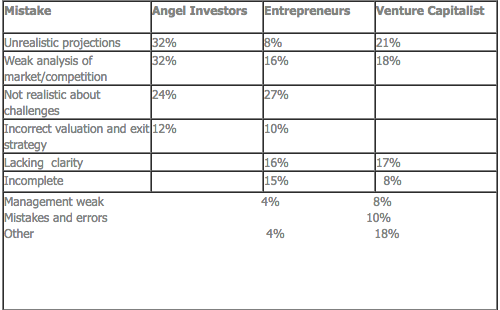
Angel investors view unrealistic financial projections as the most critical mistake (32%), and tied for first place with weak analysis of market/competition Unrealistic financial projections is also the most critical mistake cited by venture capitalists as well. Weak analysis of market/competition rates a second class ranking by both entrepreneurs and venture capitalists but that percentage is only half of the angel investors' 32%. Angel investors also felt that not only were the financial projections unrealistic but that the business plan as a whole did not adequately demonstrate how the management team could successfully develop and implement a successful business model. Interestingly, venture capitalists didn't feel it necessary to specify this as a mistake. However VCs did elaborate on several more categories that angels didn’t mention. Since venture capitalists are approached by many more entrepreneurs than angels, perhaps they have more exposure to badly written and conceived business plans. Or it could be the VCs are harsher critics of the business plan they receive. Valuation, often an area of contention between angels and entrepreneurs, has about the same ranking, 4th or 5th for both. Selected angel investor comments are in quotes below the categories
Selected angel investor comments are in quotes below the categories
Unrealistic financial projections
"Overly optimistic revenue projections and too low expense projections"
"Unrealistic revenue model"
Marketing issues
"They have the solution, but they don't know what the problem is"
"Not understanding their customer, competition and ability to deliver"
"Too optimistic about timing of benchmarks"
Unrealistic Business Plans
"Unrealistic capital requirement"
"Unrealistic pace of adoption"
Valuation
"Too greedy a valuation"
6 | The Entrepreneurs Perspective
Entrepreneurs were asked "What do you think is the most critical mistake entrepreneurs make in the business plans that they present to angel investors?" The entrepreneurs who responded to this survey question had, as a group, a remarkably thorough understanding of what can go wrong with a business plan.
Unrealistic 27%
The respondents really took their fellow entrepreneurs to task for not presenting a realistic picture of the business opportunity to investors. They told us that nearly all parts of the plan are unrealistic, except perhaps the table of contents and the appendix. Entrepreneurs said:
"Not being practical & pragmatic"
"Underestimate the time and amount of money needed to develop a product"
"Overestimate potential and underestimate competitive pressure's
"Too much BS and inflated guesses on the numbers"
"Inflating the numbers or expectations, the--'if I sold 1 cup of tea to every person in China syndrome”.
Lacking in Clarity of the Presentation 16%
The best business plans are those that are concise and to the point. The trend these days is toward shorter business plans. The 100-page magnum opus of the past has given way to a sportier, twenty-five page document. Entrepreneurs said:
"Unclear and overoptimistic projections of the expected results"
"Too involved in the details and forget to sell the sizzle"
"Too much useless information, too many numbers, not precise about what is being offered"
"Not being able to present their reason for funding in a simple and concise manner"
"Being clear and concise about what they are all about and excess of knowledge about the idea but many difficulties giving a good and easy explanation about the real business".
Incomplete 15%
Incompleteness of presentation often stems from a lack of basic homework into the market and the competition. The plan is an ideal venue for the founders of the company to demonstrate their thorough knowledge of the market space they will be entering. Unfortunately, many times the business plan content demonstrates just the opposite. Entrepreneurs said:
"Not showing profit timeline"
"Poor presentation (business plan incomplete)"
"A lack of defined objectives and poorly presented executive summary"
"Insufficient explanation of marketing and sales investment strategy and approach"
Valuation and Exit Strategy 10%
This is a controversial part of a business plan. Is it better to be extremely direct and specific about the proposed deal structure—how much equity can be given up for how much capital? Or be flexible and not state a projected return on investment and exit strategy? The experts and the investors disagree. Entrepreneurs said:
"Exit strategy is unclear of overly optimistic"
"Do not show how they will generate ROI for investors nor an exit strategy for them"
Weak business plan (i.e. no clear ROI)"
"Lack of return on investment figures"
Financial Projections 8%
With financial projections, sometimes less is more. Only 8% of entrepreneurs responded that unrealistic financial projections was the most critical mistake while both angel investors and venture capitalists ranked unrealistic financial projections as the number one most critical mistake.Entrepreneurs said:
"Too long and involved in financial numbers."
"Presenting vague or ambiguous assumptions regarding their projected cash flow statements"
"Not understanding their business start up costs, possibly due to lack of research"
Market Need 8%
For an entrepreneur to succeed in his/her mission of obtaining capital, the venture must be clearly set apart, and show to be superior, to both potential competitors in the market space, but also to other deals that are competing for the investors’ attention and dollars. Entrepreneurs tend to overlook the latter type of competition: other entrepreneurs are constantly coming up with good ideas as well.Entrepreneurs said:
"Inadequate presentation of market need and value proposition"
"Do not identify the size of the market, nor the particular niche they will compete in"
"Failing to explain what is different about the 'solution' that they offer"
Competition 8%
It is truly amazing how many business plans contain a statement like the following: “There is no competitor in our market space who is providing the same service/product that we are; therefore we do not see any direct competitors.” Entrepreneurs said:
"Not understanding their competition"
"Not thorough enough analysis of competitive landscape"
"They think they have no competitors"
Management Team 4%
It is interesting that relatively few entrepreneurs cited this as the major weakness of a business plan, whereas investors overwhelmingly view this as the critical factor in making the investment decision. Entrepreneurs said:
"Don’t focus enough on their management team and what experience they bring to the new venture"
"Lack of information on management or inexperience in their field"
7 | What is the average closing time it takes between receiving a business plan, and making the investment in the company?
Angel investors say on the average they take 67 days to close while VCs say they take 80 days, a difference of about two weeks. Is this because angel investors don’t want to take the time to perform the same careful due diligence that venture capitalists do, or because they realize they do not have the experience or resources to do so? It also may be that angel investors invest at an earlier stage than VCs and have less due diligence to perform. And of course angel investors make the decision themselves and don't have partners to share in the decision making process, which can be time consuming. While it takes the angel investor an average of 67 days to close, forty-five percent said it takes them between 31 and 60 days, 30% said between 61 and 90 days. Eighty-one percent said they close in 90 days or less. Just over 50% closed in less than 60 days. In contrast, only 19% of the venture capitalists said they closed in less than 60 days. Entrepreneurs underestimate the time it takes angels to close by 9 days; they believe angels ought to be able to get the job done in 58 days. A significant number of entrepreneurs, 24%, believe a deal should close in less than 30 days, whereas only 6% of the angels said they usually close in less than 30 days. Only 1% of VCs said they usually closed in less than 30 days.
8|Have you, as an angel investor, ever used an on-line matching service to find a company to invest in?
Not one angel investor said they had ever used an on-line entrepreneur-investor matching service. Additionally not one of the angel investors we interviewed said that they had ever used such a service. Entrepreneurs didn't think that these services were a valid way to find an investor either; only 2% thought that angel investors used them.
9|What rate of return do you expect for your investments made as an angel investor?
As can be expected there was a wide range of expectations, the least being 20%, and the highest 100%. The average was 34%. Several angel investors said they wrote off the investment mentally as soon as it was made, given the high risk of this type of investing
10|What are the most important factors relied on when valuing a company prior to making an investment?
Angel investors were asked to rank the following factors on a scale of 1 through 9, 9 being the most important factor, 1 being the least important:
Return on Investment
Quality of management
Stage of development of the company
Proprietary product
Size of market
Growth potential
Competition
Barriers to entry
Industry the company is in
Other please specify
Entrepreneurs were asked to rank how they thought angels would rank the factors. Venture Capitalists were also asked to rank the factors in importance when they make an investment.
FACTORS
Quality of Management
Growth potential
Barriers to competitive entry
ROI
Competition
Proprietary (unique) product
Size of market
Stage of development of the company
Industry the company is in
Angels
Pts | Rank
7.1 | 1
4.7 | 2
4.2 | 5
3.9 | 7
4.0 | 6
4.4 | 3
4.3 | 4
3.7 | 9
3.8 | 8
Entrepreneurs
Pts | Rank
5.5 | 1
5.4| 2
5.4 | 2
5.3 | 4
5.3 | 4
5.1 | 6
5.1 | 6
5.1 | 6
4.9 | 9
Venture Capitalists
Pts | Rank
5.4 | 1
2 | 4
4.1 | 7
4.2 | 4
4.2 | 4
4.4 | 3
4.6 | 2
3.8 | 8
3.6| 9
Not surprisingly Quality of Management was the number one factor for angels, entrepreneurs and venture capitalists. Stage of Development, and Industry are ranked in last place by all three as well. Growth Potential is ranked second by angels and entrepreneurs, and ties for fourth place with Competition and ROI in the VC rankings. Product is ranked third by both angels and venture capitalists, but in sixth place by entrepreneurs.
Entrepreneurs had very little variation in rank from the top factor to the bottom, only six tenths of one point comprises the difference in the average rank from the top factor to the last place factor. The range for angels is 3.3 points. Entrepreneurs considered Quality of Management the top factor but not by much. With each of the factors, a significant number of entrepreneurs said it was most important, and a significant number said it was the least.
Even in the case of Quality of Management, roughly 40% of the entrepreneurs ranked it 9 or 8, and 30% ranked it 1 or 2 in importance. Well over half of the Angels rated management as the most important factor; 60% gave it a 9 or 8 and only 10% gave it a 1or 2 in importance. The data showed that many entrepreneurs just aren’t sure what factors are most important. Many of them gave all the factors a 6 or 7, for example. The fact that entrepreneurs, who sometimes are accused of being too much in love with their product, ranked product uniqueness lower than other key factors, was a positive thing to see.
How alike are angels and venture capitalists?
FACTORS
Quality of Management
Growth potential
Barriers to competitive entry
ROI
Competition
Proprietary (unique) product
Size of market
Stage of development of the company
Industry the company is in
Angels
Pts | Rank
7.1 | 1
4.7 | 2
4.4 | 3
4.3 | 4
4.2 | 5
4.0 | 6
4.9 | 7
3.8 | 8
3.7 | 9
Venture Capitalists
Pts | Rank
5.4 | 1
4.2 | 4
4.4 | 3
4.6 | 2
4.1 | 7
4.2 | 4
4.2 | 4
3.6 | 9
3.8 | 8
The top four factors for angels, Quality of Management, Growth Potential, Product and Size of the Market are also the top four factors for venture capitalists. Two of those factors have the same ranking, Quality of Management and Product. The last two factors are also ranked the last two by VCs. VCs ranked Growth potential, Competition and ROI in fourth place while angels ranked them second, sixth and seventh respectively. Angels have a variance of 3.3 points while VCs a variance of 1.6. It seems VCs don't differentiate as much as angels do. Management is given a higher average point score by angels than by venture capitalists. Since angels invest earlier it may be that the management team is even more important to angels than VCs.
Dee Power and Brian E. Hill, are authors of the books Attracting Capital From Angels: How Their Money and Their Experience Can Help You Build A Successful Company, (John Wiley & Sons) 2002 and Inside Secrets To Venture Capital, (John Wiley & Sons) 2001, and founders of Profit Dynamics Inc.